
Without online traffic orchestration
Traffic hits your systems unmanaged
Bots & bad actors flood your site & apps
Scaling costs surge & bottlenecks still fail
Teams react manually as conditions change
Frustrating online experiences shatter brand trust
With online traffic orchestration
Every visitor is evaluated at the digital front door
Block bots with AI-powered mitigation
Protect infrastructure without overprovisioning
Automate traffic decisions from one platform
Fair & reliable experiences for every visitor
Load balancers distribute traffic, not access
They route requests but don't decide who gets in, when, or why
CDNs optimize performance, not demand
They improve delivery but don't regulate demand or access
Security tools assess risk, not fairness
They identify threats but don't prioritize or enforce fair access
Scaling adds capacity, not certainty
It absorbs more traffic but doesn't shield systems from spikes
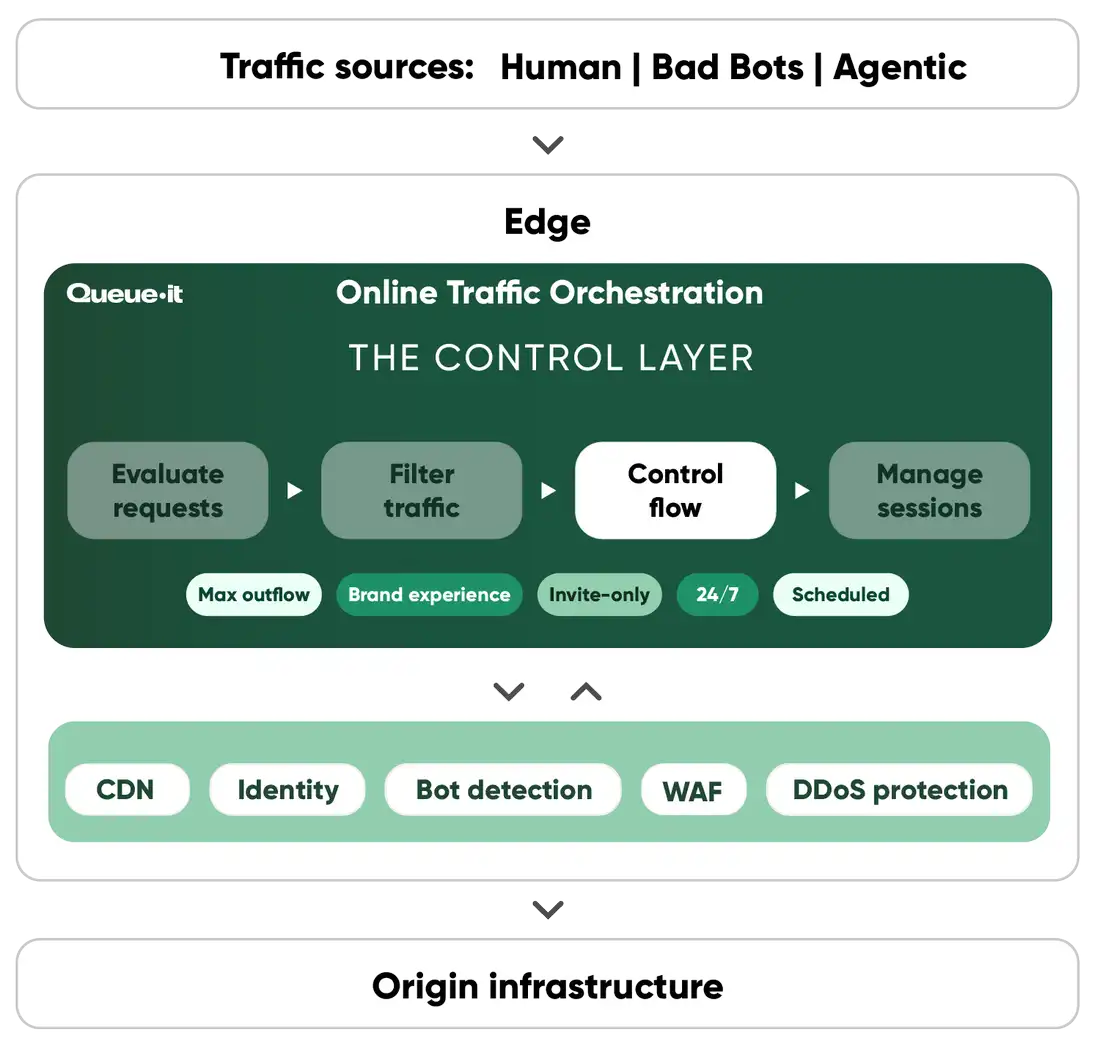
- Decide which visitors, pages, actions, or APIs should be protected by traffic orchestration
- Apply custom traffic handling rules based on URLs, headers, cookies, or identity
- Get real-time visibility and control over all traffic entering your digital front door
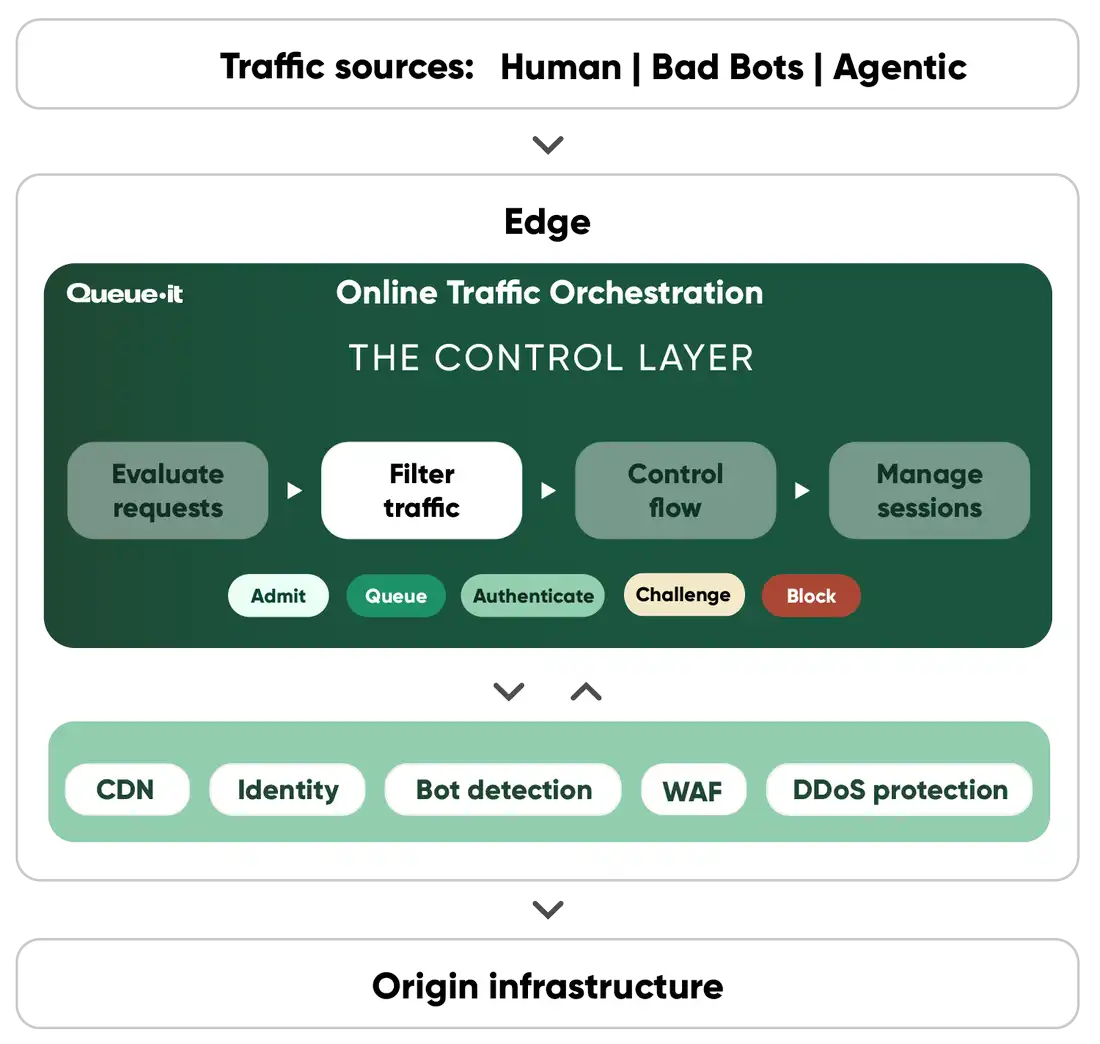
- Block, challenge, authenticate, queue or bypass visitors using configurable access rules
- Integrate traffic control with advanced AI-powered bot detection for robust security
- Whitelist support staff or provide exclusive or early access to VIP visitors based on identity
- Control how many visitors reach your systems by activating a waiting room when demand exceeds capacity, preventing overload and crashes
- Allocate limited inventory fairly with access mechanisms like randomization, first-in-first-out queuing, and invite-only entry
- Deliver transparent wait information and an interactive, on-brand visitor experience
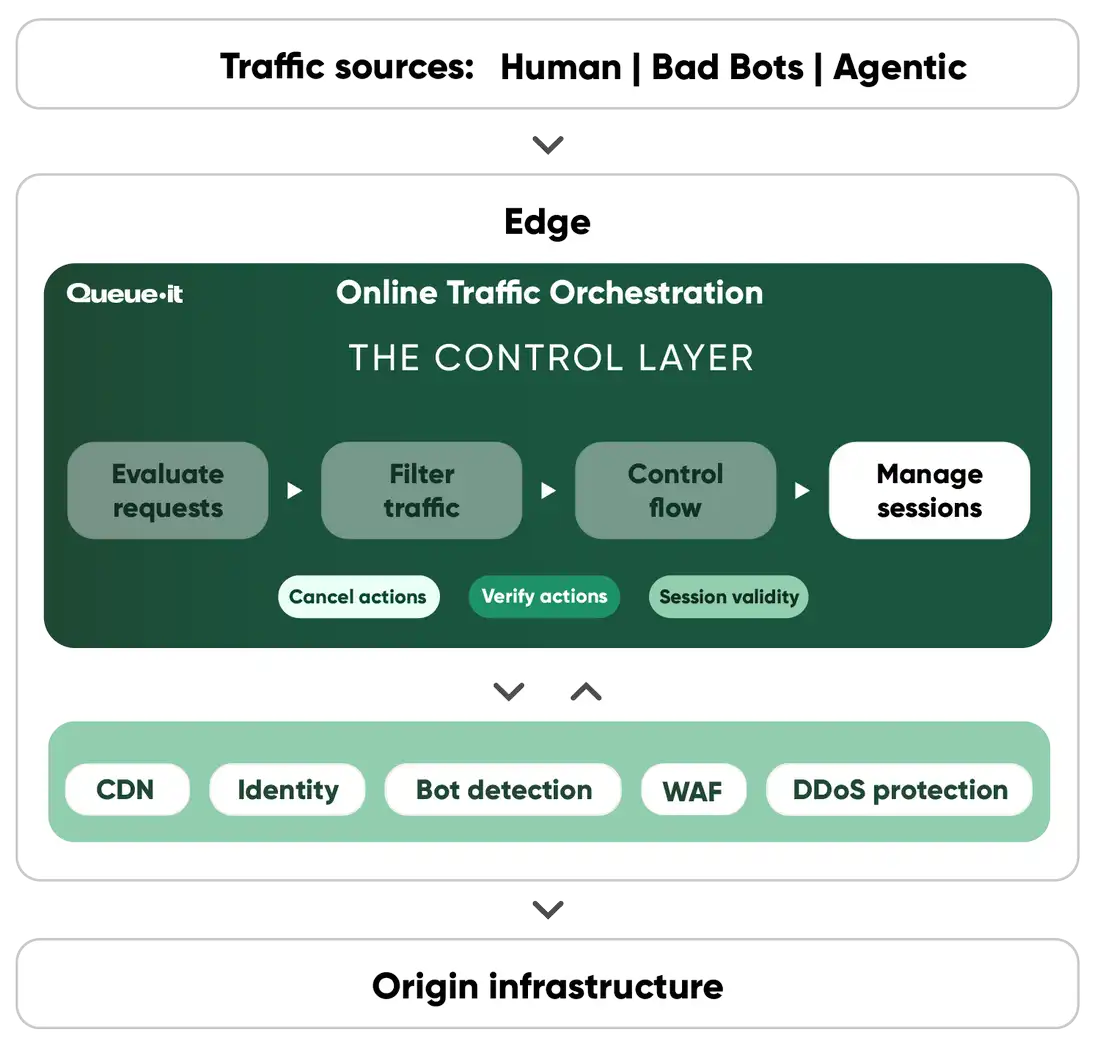
- Ensure visitors move quickly through your systems by setting session validity windows
- Apply additional checks at checkout to ensure one purchase per visitor
- Cancel session validity after key actions like purchase to free up capacity for new visitors
daily visitors through Queue-it's online traffic orchestration engine
visitors orchestrated by Queue-it in 2025
visitors through Queue-it's waiting rooms in 2025
24/7 Protection
Protect every critical moment, automatically
- Get round-the-clock protection for your whole site, specific pages, or just bottlenecks like checkout or login
- Detect surges and automatically activate a first-in-first-out waiting room the instant traffic crosses thresholds
- Apply your Traffic Access Rules to every request, continuously evaluating, challenging, and blocking traffic
- Gain real-time visibility and control over demand, malicious traffic, and visitor details like behavior, device, and geography
Planned events
- Run scheduled onsales, registrations, and drops with pre-queue randomization and first-in-first-out ordering, so speed and bots don't decide who gets first access
- Deliver exclusive, invite-only sales with single-use invitations, an unskippable queue, and MFA
- Flow traffic to your infrastructure at the exact rate you choose, protecting systems while cutting scaling spend
- Adjust throughput, rules, and priorities on the fly, and then review every event with detailed reports
Orchestration rules
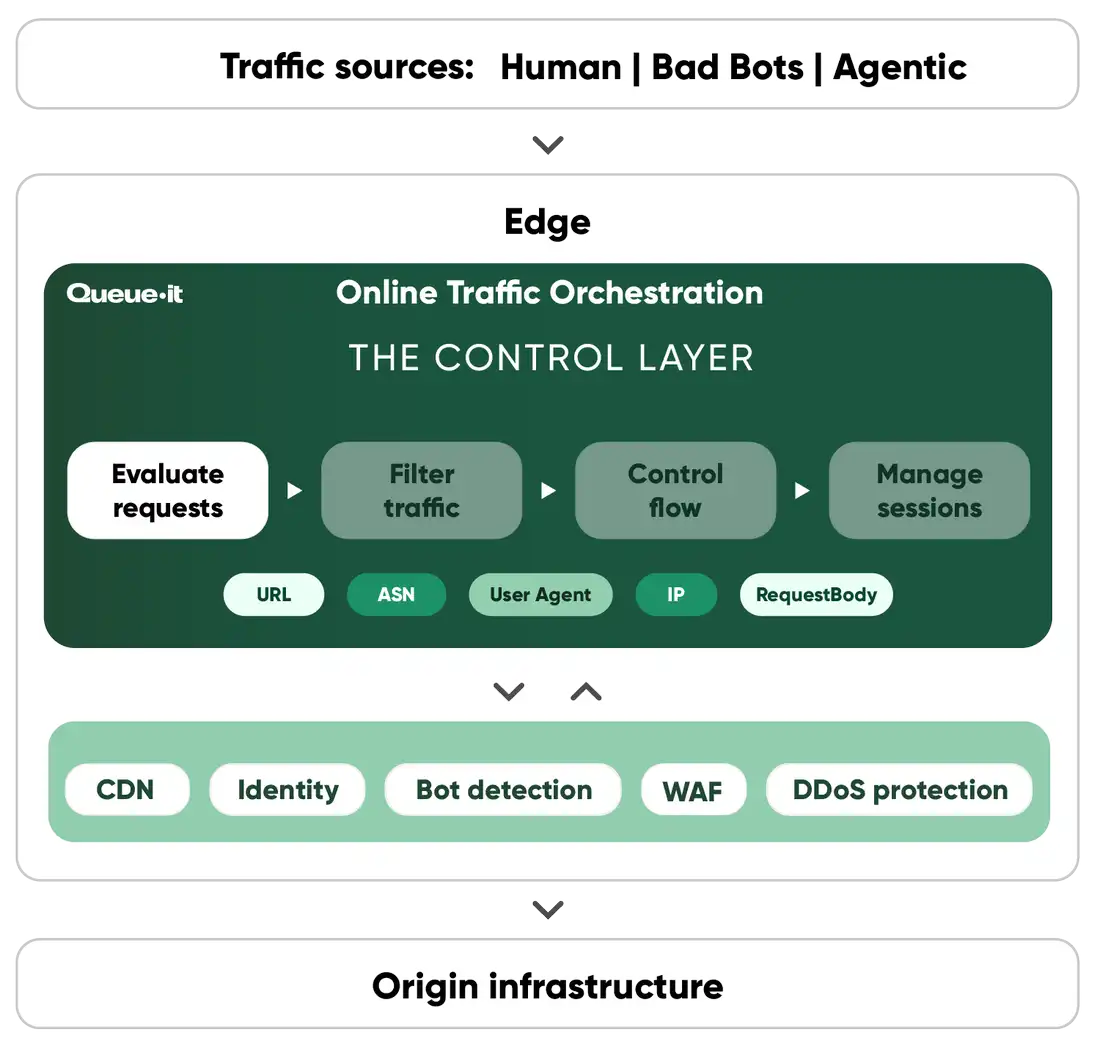
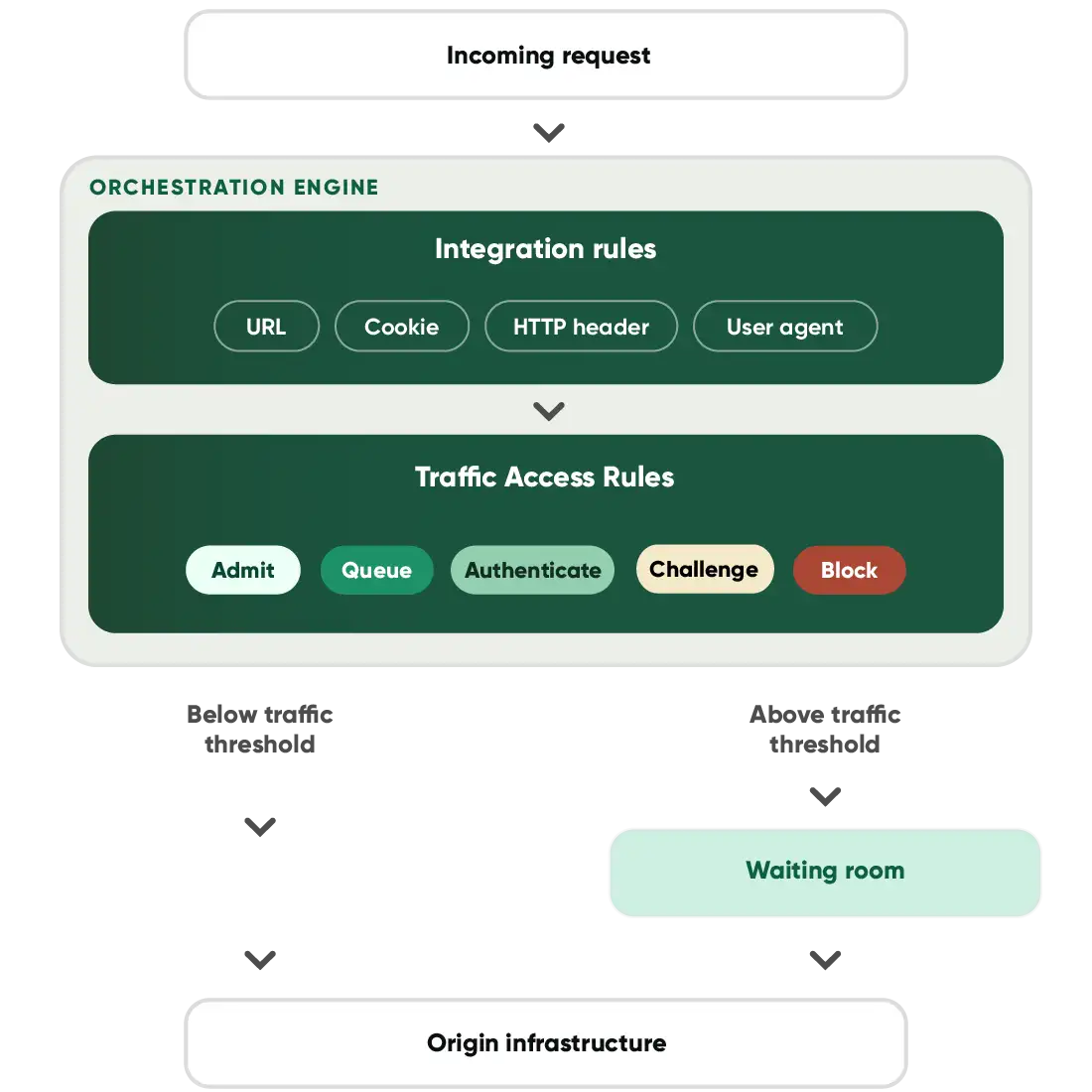
- Evaluate every request with Integration Rules to decide exactly what to protect, from your whole site to a single "add to cart" action
- Filter traffic with Traffic Access Rules that block, challenge, or bypass queue visitors based on signals you choose
- Whitelist support staff and good bots, so the right people always get immediate access
- Adjust every condition and your outflow rate live, with no code redeploy, all from one control center
Bots & Abuse Protection
- Block data center and aggressive IPs and challenge suspicious visitors with Proof-of-Work or CAPTCHA
- Catch malicious behavior automatically with Anomaly Detection and proprietary reputation scores
- Leverage AI-powered detection with Hype Event Protection powered by Akamai for fairer, faster sales
- Boost fairness and detection on scheduled events with pre-queue randomization, more time to catch bad signals, and invite-only access
Traffic Intelligence
- Get real-time, server-side data on demand, bots, and visitor details like behavior, device, and geography
- Act on what you find without switching tools, adjusting rules and throughput live from the same platform
- Catch anomalies as they happen with automated alerts, and share live status securely with stakeholders
- Explore six dashboards, from at-a-glance health checks to request-level logs with 30+ filters
Brand Experience
- Replace crashes, errors, and stalled pages with a branded waiting room that keeps visitors informed
- Capitalize on wait time to cross-sell, promote offers, and capture zero-party data with quizzes, polls, and sign-ups
- Customize the brand experience with AI, or any combination of HTML, CSS, and JavaScript
- Match your brand down to your logo, fonts, colors, and URL, white-labeled across 50+ languages










88%
say their customers' online experience improved
94%
say they've prevented site performance issues
80%
say they sell through product more efficiently

"The peace of mind we get from using Queue-it is outstanding. The best thing is feeling relaxed, not having to worry, knowing that everything will be okay. The virtual waiting room reacts to and controls our traffic instantaneously, and if we need to make any changes, we can easily do it on the spot with the API or the dashboard.”
THIBAUD SIMOND, INFRASTRUCTURE MANAGER

“Queue-it’s a great bolt-on piece of infrastructure, completely dynamic to our needs. The virtual waiting room made much more sense than re-architecting our systems to try to deal with the insanity of product drops that take place a few times a year.”
TRISTAN WATSON, ENGINEERING MANAGER

“I can count on one hand the number of times in my career I've implemented a new technology and it exceeded my expectations. Queue-it is one of those times, both in how easy it is to implement, and in how well it works.”
DENIS GOULET, NEW HAMPSHIRE STATE CIO
*Based on 203 survey responses from Queue-it customers (2025).
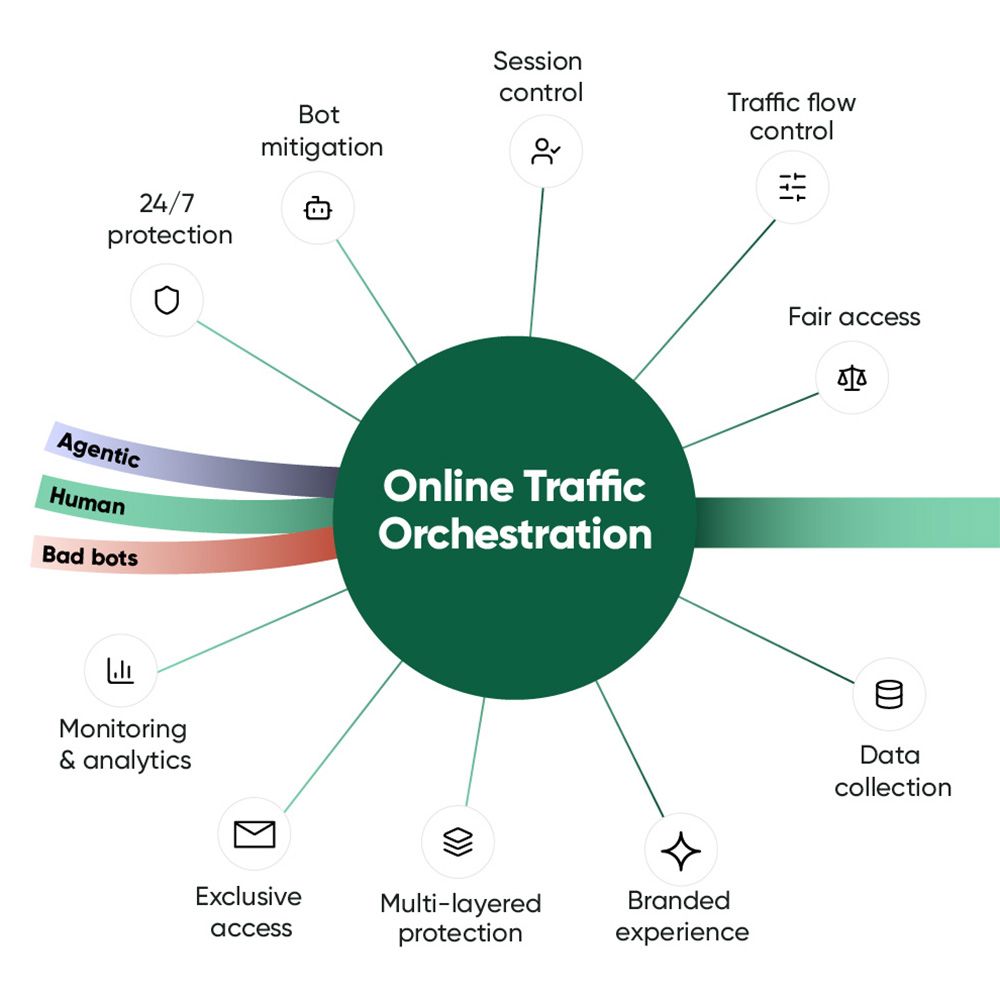
Online traffic orchestration provides real-time visibility and control over traffic to web applications. Based on identity, intent, and context, it dynamically routes, filters, or transforms traffic composition to suit business goals, system capacity, and security requirements.
They’re complementary layers, not substitutes. A CDN optimizes how traffic is delivered: speed, scale, and reliability. Online traffic orchestration decides who gets access, when, and under what conditions.
Queue-it is CDN- and infrastructure-agnostic, sitting across any CDN or multi-CDN setup with 25+ connectors, and partners with CDNs like Akamai rather than competing with them.
In short: a CDN ensures traffic can reach your site. Queue-it decides who gets in. Together, they deliver fast and fair experiences.
Scaling your systems is a good idea, but it’s often not enough to ensure systems perform no matter the demand. Relying on autoscaling alone comes with these challenges:
- It’s expensive to scale servers and databases to many multiples of baseload capacity
- It’s risky because some systems may not scale (for example legacy backends, login, payment, and other third-party systems) and visitor traffic and behavior is hard to predict
- It’s reactive, so if traffic spikes in seconds and it takes minutes to spin up servers, that’s too little too late
- It’s labor intensive because it requires expertise and active monitoring to ensure it’s meeting the demand
Using Queue-it to control traffic flow can help you:
- Reduce costs of scaling servers and databases
- Remove the risk of systems breaking because a key bottleneck can’t scale
- Minimize work needed to keep systems online 24/7
When traffic exceeds the capacity you’ve set, Queue-it activates a waiting room that holds excess visitors on its own infrastructure and flows them to your site at a rate your systems can handle. Bottlenecks like databases, logins, and payment gateways never receive more traffic than they can process, so spikes don’t turn into crashes, slowdowns, or oversold orders. 94% of Queue-it customers say they’ve prevented site performance issues from peak traffic.
Load balancers and virtual waiting rooms solve different problems. In high-demand scenarios, one doesn’t replace the other. A load balancer is stateless and distributes requests across servers. It scales well, but it doesn’t control traffic volume. It passes requests through, even if your backend or third-party services can’t handle the load. If capacity is exceeded, users hit HTTP 429 errors, timeouts, or degraded performance.
Queue-it’s virtual waiting room controls the flow of incoming traffic, ensuring your systems don’t exceed capacity. During spikes, it offloads visitors to Queue-it’s infrastructure and lets them through in a controlled, fair order while providing estimated wait times and a branded experience.
In short, the virtual waiting room protects your stack during peak situations, and load balancers help scale what traffic is allowed through. Most resilient systems use both.
When visitors are placed in the waiting room depends on how you set up Queue-it. First, you can choose whether the waiting room should be “Always Visible” or “Visible at Peak”. If you choose “Visible at Peak”, the waiting room will activate only when traffic exceeds the threshold you’ve set.
Second, you choose the parts of the user flow that Queue-it covers. This could be your entire website, a landing page, the login page, or a dynamic request like when customers click “Add to Cart”. This way, you queue visitors only at the stage in the user journey that needs protection, while visitors who haven’t taken the protected action can browse the site normally. You can trigger the waiting room based on six trigger parameters:
- URL
- Request body
- User agent
- Cookie
- HTTP header
- JavaScript variable
If you had unlimited inventory and your website was infinitely scalable, you wouldn’t. But otherwise, uncontrolled traffic risks your customer experience and bottom line. Higher demand than inventory makes it hard to allocate product fairly, reward loyal customers, and keep bots and resellers at bay. And higher traffic than site capacity can overheat hard-to-scale bottlenecks, crash or slow your site, and ruin your team’s productivity.
For most businesses and customers, an informed wait is better than a slowed or crashed site. Our research shows 87% of consumers prefer a short wait for a working website over immediate access to a slow or buggy one. On average consumers are willing to wait 53 minutes in an online queue for a limited-inventory product they want.
And it’s not just the length of the wait that matters — it’s how people feel while they wait. Advanced waiting rooms harness queue psychology to improve the experience and turn waiting into anticipation and progress.
Explore how consumers feel about waiting online
You choose the rate at which visitors flow from the waiting room to your site, measured in visitors per minute, and can adjust it up or down on the fly using the GO Platform or API.
The best way to determine your rate is a load test. If you haven’t run one, Queue-it’s peak traffic experts bring years of expertise in identifying system bottlenecks, understanding how many visitors your infrastructure can handle, and recommending a starting level that’s optimal for your site’s performance.
Not in a way your visitors will notice. Integration Rules execute inside your connector, at your CDN edge or on your own server, as part of normal request handling rather than as a call out to a third party, and Traffic Access Rules are enforced on Queue-it’s infrastructure before traffic ever reaches the waiting room or your site.
In recent load testing, the Queue-it tier that evaluates requests sustained an average response time of roughly 4 milliseconds, with brief peaks below 7 milliseconds.
When a visitor is placed in the waiting room, the wait is deliberate rather than incidental: they are held on Queue-it’s infrastructure and released to your site at the rate you set.
With Queue-it’s latest Edge integrations, your visitors keep reaching your site. The connector is designed to fail open: if Queue-it cannot be reached, requests continue through to your origin uninterrupted rather than being held or dropped.
Queue-it also sits beside the request path rather than inside it. It is not implemented as a reverse proxy, and no payload, session, or personally identifiable data from your site passes through it.
The platform is cloud hosted on global AWS infrastructure and processes an average of 100 million visitors a day, with regional hosting in the European Union, the United States, Brazil, and Japan.
The waiting room is a lightweight solution built specifically to avoid bottlenecks and handle extreme load, meaning holding users is less resource-intensive than on typical sites or apps. Queue-it is cloud hosted on global AWS infrastructure, built to scale to extreme demand. Queue-it processes an average of 100 million visitors daily.
You can integrate Queue-it with a client-side, server-side, edge, or mobile SDK connector. Queue-it offers over 25 connectors and dedicated support staff for implementation.
Yes, Queue-it can be used on mobile devices and integrated into iOS, Android, Cordova, or React Native app frameworks. Visitors on a desktop can even transfer their position in queue to their mobile device if they need to queue on the go.
You can show the waiting room in 50+ languages to tailor the experience to your markets.
Because Queue-it is not implemented as a reverse proxy, you don’t expose any sensitive data. Our interaction with your system is as if the visitor entered the URL, then the Queue-it URL in the browser, waited, and entered the URL for your website again. No Queue-it end-point has payload or session data from the protected site, including credit card and/or personally identifiable information.
Queue-it is certified to ISO/IEC 27001:2022, ISO/IEC 27017:2015, and ISO/IEC 27018:2019, and compliant with GDPR and NIS 2. You can choose whether your servers reside in the European Union, the United States, Brazil, or Japan, based on your requirements.
Explore security and compliance